Key details
- Current boat name
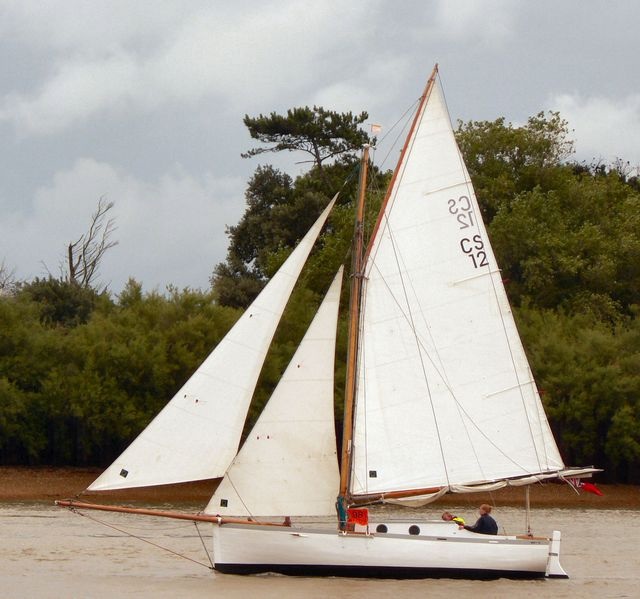
- Fanny of Cowes CS 12
- Boat class
- 7169
- Sail number
- CS 12
- Function
- Fishing and Hunting
- Type
Dimensions and specifications
- Length (m / ft)
- 6.71 / 22ft
- Beam (m / ft)
- 2.54 / 8ft 4in
- Leeward
- Keel
- Masts
- One
- Rig type
- Gaff Sloop
- Propulsion
- Sail
Design and build
- Design date
- 1853
- Date of build
- 1872
- Place of build
- Cowes
Current status
- Present use
- Sailing
History
Built at Cowes for the Paskins Family. FANNY’s lines were taken from the Paskins existing fishing boat- the STAR, a 21 footer that entered town regattas and was reputedly never beaten. STAR's fame caused Mr Grant, Secretary of the Royal Yacht Squadron, to request the permission to have her lines taken off by J. S. White at Cowes- so that they could be enlarged in direct proportion to build him a Yacht (DOLLY VARDEN). Mr Paskins took charge of DOLLY VARDEN when racing and steered her to victory for Mr Grant for several years.
In 1872, Mr Paskins son Edmund was old enough to have his own fishing boat. Naturally, it was decided to build her on lines taken from STAR - increasing her length by 1ft and her beam to 8ft 4in. John Watts of Cowes was contracted to build the new boat. She was built in the owners back garden- No 1 Pelham Place, Cowes. Young Edmund Paskins assisted John Watts in her building- his job being to coat every piece of timber with two coats of linseed oil. On completion she was named FANNY. The end of the shed and garden wall were removed and FANNY was taken to be launched at the old town quay. That year, both STAR and FANNY were entered into the town regatta. FANNY won their class by a few lengths from STAR in a half gale, westerly.
Although built as a fishing boat in 1872 FANNY was not registered with a fishing number until 1902- when she was allocated CS 12. She was primarily used for prawning, working a 12ft beam trawl, but she was also used for carrying oysters from the family’s layings in Newtown. FANNY was sold for use as a yacht in 1920. She dominated racing in the early days of the Old Gaffers Association in the 1960’s, and continues to win races to this day. She is unusual in that she has never been rebuilt and contains much more original material than you would expect in a boat of her age. GH Sep 2009
Significance : Although approaching 150 years old, this example of a locally designed work boat continues to race successfully and has never been re-built.