Key details
- Current boat name
- Crandall Hydroplane C Class Flyer
- Boat class
- 7150
- Function
- Sports and Leisure
- Type
Dimensions and specifications
- Propulsion
- Engine
Design and build
- Design date
- 1930
- Date of build
- 1944
Current status
- Present use
- Museum/NMMC
History
Hydroplanes were developed in the 1920’s and 30’s as outboard engines became available and increased in size and power. Originally outboards were used on utility boats but as racing evolved and speed records were set hydroplanes were designed as a way of going much faster. This particular boat was designed by a naval architect named Bruce Crandall and the plans were published in the 1935 edition of Motorboating magazine.
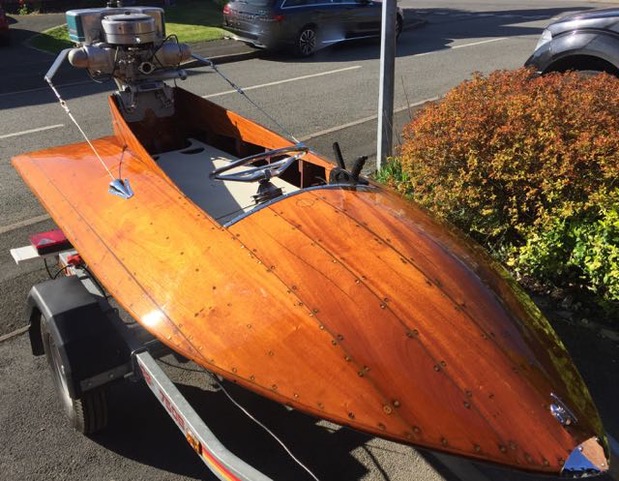
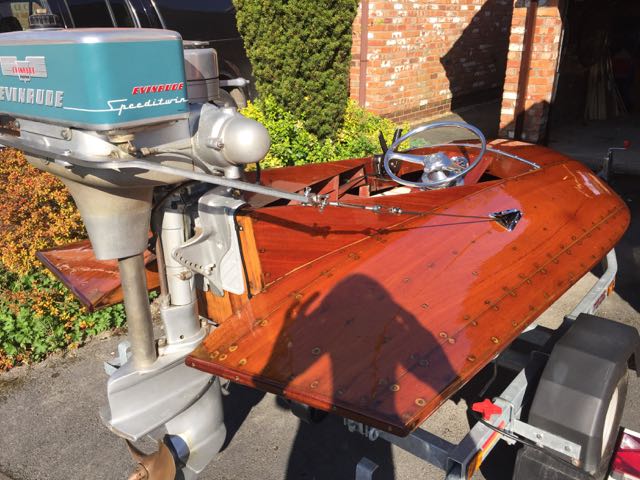
The maker of this Class C Flyer is not known. It is built almost exactly to the specification on the plans with a spruce frame, 1/4 inch mahogonay planking and many hundreds of brass screws. The steering wheel is an aluminium Quicksilver hydroplane wheel with a large diameter reel to allow the engine to turn enough with small one handed movements. The original steering wheel which was beyond restoration allowed the hydroplane to be dated as the steering wheel boss was actually a ha’penny coin depicting the Golden Hind welded on -on which you can just see the numbers 44- meaning it was fitted around 1944.
Class C refers to the outboard size- in this case 20-30 cubic inch capacity- in practice a 22.5Hp engine. The driver kneels with one hand on the wheel and another on a deadman’s throttle. An assistant starts the engine- there is no clutch- you would just shoot off. With their light weight and flat bottom (there is a small ‘step’ on the bottom to provide lift) and powerful engine, speeds were in excess of 50mph.The outboard fitted is a ‘stock’ 1944 engine- reputedly unused from equipment produced in preparation for an American invasion of Japan which was not needed after the use of atomic bombs shortened WW2.
Although raced and used for speed records these were also just used for leisure, this particular boat was used for fun on Windermere and Carr Mill Dam in the 1950’s.