Key details
- Current boat name
- Zetland
- Boat class
- 7099
- Function
- Service
- Type
Dimensions and specifications
- Length (m / ft)
- 9.45 / 31ft
- Beam (m / ft)
- 3.2 / 10ft 6in
- Leeward
- Keel
- Propulsion
- Oar
Design and build
- Designer
- Greathead H
- Date of build
- 1802
- Place of build
- South Shields
Current status
- Present use
- Museum/RM
History
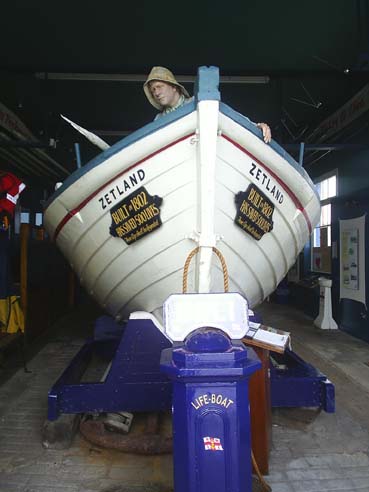
ZETLAND is the world’s oldest existing lifeboat and sole survivor of the 39 lifeboats designed and built by Henry Greathead. There remains some confusion over who designed the first lifeboat, but Greathead was awarded the ‘prize’ for ORIGINAL in 1790, and then built 38 more, ZETLAND being No 11. The funds to build her (£200) were raised by local fisher-folk with the assistance of Lord Dundas and the Reverend Y Williamson. ZETLAND was stationed at Redcar on 7 October 1802 and christened in honour of the Lord of the Manor. She saw 78 years of service and saved over 500 lives.
ZETLAND is clinker built of larch planking on oak frames. The forward and aft quarters of the boat are identical in construction, giving a classic ‘double-ender’ structure. A wooden rocker keel is protected by a ferrous metal keel-band fitted from stem to stern. There are six thwarts, supported at their centre by turned wooden stanchions. The bulwarks form the outer sides of built-in ‘water-tight’ compartments that are an intrinsic part of the structure. The extreme hull shape and her clinker construction would require very wide boards if finished in single lengths, so the strakes are formed of varying planks of wood scarped together. The hull is copper nail and rove fastened and has therefore largely not been affected by wood metal reaction. In 1858, the RNLI took over ZETLAND from the Teesbay Lifeboat and Shipwreck Society. They maintained her until September 1864 when a new boat CROSSLEY was launched at Redcar. ZETLAND was hauled to the beach and an RNLI joiner was ordered to destroy her. However, the town folk resented this and it was arranged that Redcar could keep the boat as long as she did not compete with CROSSLEY. Sufficient funds (£100) were raised for her repair at South Shields in 1872. A lifeboat rowing race of four boats was held which ZETLAND won. During the intervening years her humanitarian work continued, culminating in the rescue of the brig LUNA in 1880 when CROSSLEY, EMMA and ZETLAND were launched, saving 7 lives. Being homeless, a brick shed was built for ZETLAND at the end of Granville Terrace and she was then used for salvage and other odd jobs. Eventually Lord Zetland gave her refuge in a barn at Marske. In 1905, a representative body was formed by local fishermen and the lifeboat committee and over £280 was collected to buy the Free Gardeners lifeboat house (formerly housing EMMA). ZETLAND was moved there and handed over the Redcar Borough Council. On 20 March 1907, the boathouse was opened for public inspection. ZETLAND was later closed away from public eyes for 17 years during and after the Second World War until the Redcar Ladies Lifeboat Guild opened the Free Gardeners Lifeboat House. From 1957 to 1960, the interior remained the same until the Council finally made some improvements and alterations. In May 1963, ZETLAND undertook a long journey to Edinburgh to be the centerpiece at the International Lifeboat Conference in a specially built cradle. In 1969, Redcar Borough Council ceased to exist and the residents became part of Teesside County Council. The museum was refurbished and opened with paid attendants in 1969. This only lasted 5 years until the Museum was closed. A 'Save ZETLAND' campaign was launched and it was finally agreed that the museum and lifeboat would be transferred to the RNLI. ZETLAND is now inspected biannually by the RNLI to maintain preservation and on 29 April 1988, the boathouse became a listed building. Source: John Kearon, Advisory Committee, March 2009. Significance: Oldest existing lifeboat in the world and example of Greathead design